AI Tools Could Help Address Climate Migration Inequality
Artificial intelligence and climate migration equity
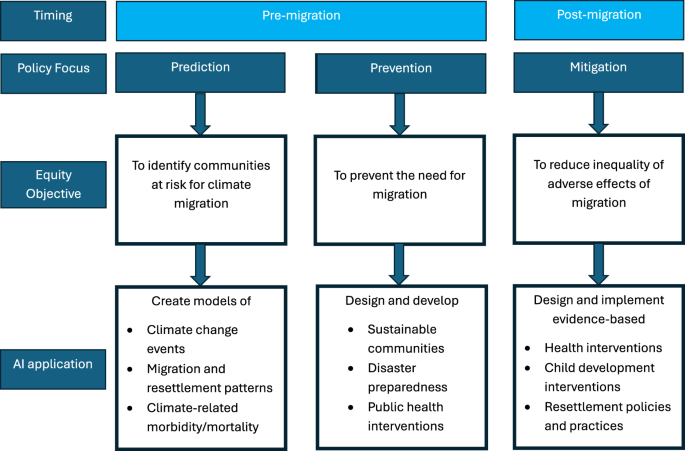
In recent years, there has been a significant increase in the number of people displaced by climate-related damage to the physical and social environment. These migrants are more exposed to climate-related environmental damage than others and more vulnerable to its social and health impacts because they possess fewer resources for mitigation and adaptation. Emerging artificial intelligence (AI) tools and approaches may help improve understanding of climate migration and immobility and support more timely, equitable interventions to reduce avoidable harm before, during, and after displacement. While AI systems have already been applied to climate modeling, disaster forecasting, and public health surveillance, their adaptation to the context of climate-induced displacement remains under-studied and unevenly implemented. Specific AI applications can address the lived realities and systemic vulnerabilities of climate migrants, such as anticipatory relocation, equitable health service provision, and sustainable infrastructure in host regions. However, we must first address certain issues such as the risk of fostering greater inequality through inherent biases in training data; developing public-private-academic collaboratives to collect and integrate high-resolution, localized and open-access datasets tailored to address disparities; prioritizing energy-efficient algorithms and hardware and balancing performance with environmental sustainability; and developing responsible models of AI governance that capture co-design and co-ownership of the design process with climate migration stakeholders including vulnerable and affected communities. We therefore call for empirical research to document the effectiveness of current and proposed initiatives to apply AI in supporting climate migration equity and overcoming methodological and operational limitations and implementation risks. By aligning technological innovation with human-centric values and global justice, AI may contribute to shifting climate mobility policy from crisis response toward resilience-building, if paired with rights-based governance and accountable implementation. While most applications remain pilot-based, context-specific, and unevenly evaluated, this article advances a structured framework to guide future empirical research and governance.
Artificial intelligence applications show promise in supporting climate migrants facing displacement from environmental damage, yet implementation remains uneven and under-studied. Researchers propose AI for anticipatory relocation, health services, and infrastructure planning, but warn against algorithmic bias and call for collaborative governance with affected communities. A structured research framework is needed to evaluate effectiveness and ensure equitable, rights-based outcomes.
Original Article
Read full article on NatureExplore More
Related News

The National Policy Framework on Artificial Intelligence: Implications for Employers Using AI | JD Supra
Need-to-Know News, Insights, & Intelligence for Business Leaders | JD Supra · 2026.04.03

Worried about AI? LinkedIn CEO reveals 5 skills artificial intelligence won’t replace
Financial Express · 2026.04.05

The AI Cryptocurrency That Could Benefit From the Artificial Intelligence Boom
The Motley Fool · 2026.04.05

Chainalysis Deploys AI Agents to Counter Criminal Use of Artificial Intelligence in Crypto
Bitcoin News · 2026.04.04

Artificial Intelligence and Clinical Decision Making
Home · 2026.04.04

Samsung SDS has proposed a supply chain innovation strategy with artificial intelligence (AI) at the.. - MK
매일경제 · 2026.04.04